
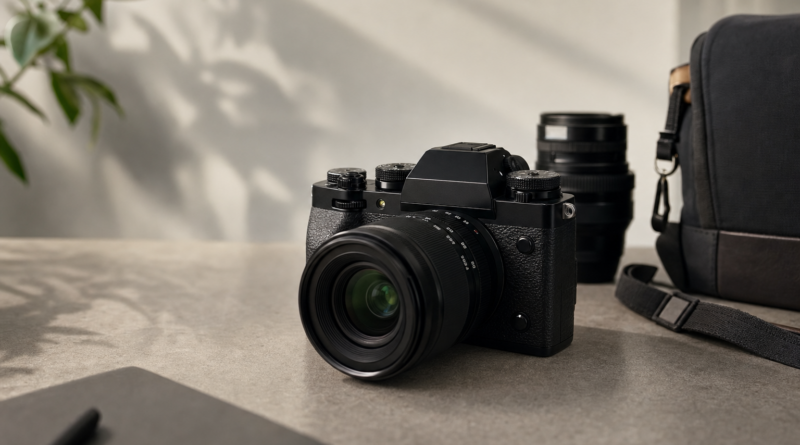
Fujifilm X-T5 Review: The Best APS-C Camera for Photographers?
Quick Verdict: Who Should Buy the Fujifilm X-T5?
The Fujifilm X-T5 is one of the strongest APS-C cameras for photographers who care about image quality, classic controls, film simulations, portability, and a more deliberate shooting experience. It has a 40.2MP X-Trans CMOS 5 HR sensor, X-Processor 5, in-body image stabilization rated up to 7.0 stops, and Fujifilm’s traditional top-plate dials for ISO, shutter speed, and exposure compensation.
It is not the best Fujifilm body for every buyer. If you are primarily a video creator, sports shooter, or someone who wants the easiest automatic experience possible, another camera may fit better. But if your priority is photography — street, travel, portraits, landscapes, documentary, family, or everyday shooting — the X-T5 is still a very compelling camera.
Check Fujifilm X-T5 prices on Amazon
| Category | Fujifilm X-T5 Verdict |
|---|---|
| Best for | Photographers who want high-resolution APS-C files, Fujifilm color, and classic controls |
| Not ideal for | Video-first creators, sports/wildlife specialists, and buyers who want simple auto-first controls |
| Main reason to buy | Excellent still-image quality in a compact, tactile Fujifilm body |
| Main reason to skip | Not the most video-first or action-first Fujifilm camera |
| Best starter lens | Fujifilm XF 16-50mm f/2.8-4.8 R LM WR |
| Best portrait lens | Fujifilm XF 56mm f/1.2 R WR |
| Best everyday prime | Fujifilm XF 33mm f/1.4 R LM WR |
Fujifilm X-T5 Key Specs
| Feature | Fujifilm X-T5 |
|---|---|
| Sensor | 40.2MP APS-C X-Trans CMOS 5 HR |
| Processor | X-Processor 5 |
| Lens mount | Fujifilm X-mount |
| Stabilization | 5-axis in-body image stabilization, rated up to 7.0 stops |
| ISO range | ISO 125–12,800 native for stills |
| Video | Up to 6.2K recording |
| Storage | Dual SD card slots with UHS-II support |
| Controls | Dedicated ISO, shutter speed, and exposure compensation dials |
| Best use | Photography-first APS-C shooting |
Fujifilm’s official X-T5 specifications list the 40.2MP APS-C X-Trans CMOS 5 HR sensor, X-Processor 5, ISO 125–12,800 standard still-image range, 5-axis IBIS rated up to 7.0 stops, and dual SD card support with UHS-II compatibility.
Design and Handling: This Is a Photographer’s Camera
The Fujifilm X-T5 is built around a simple idea: give photographers direct control instead of hiding everything in menus. The top plate has dedicated dials for ISO, shutter speed, and exposure compensation, which makes the camera feel different from many modern mirrorless bodies.
This matters more than beginners realize. A camera with visible exposure controls teaches you how photography works. You can see your settings before turning the camera on, make quick adjustments without menu diving, and build muscle memory faster.
Buy it if:
- You want to learn photography seriously.
- You like physical dials and tactile controls.
- You shoot street, travel, documentary, portraits, or landscapes.
- You want a compact APS-C body that still feels premium.
Skip it if:
- You want a simple “leave it in auto” camera.
- You prefer a PASM dial and modern hybrid controls.
- You shoot mostly handheld vlogs or video where a fully articulating screen matters more.
Image Quality: The Main Reason to Buy the X-T5
The X-T5’s biggest selling point is image quality. Its 40.2MP APS-C sensor gives photographers far more resolution than many competing APS-C cameras and even some full-frame models. Fujifilm says the X-Trans CMOS 5 HR sensor uses an enhanced image-processing algorithm designed to improve resolution without compromising signal-to-noise ratio.
In practical terms, the X-T5 is excellent for photographers who crop, print, shoot landscapes, capture street scenes, or want detailed travel images. The high-resolution files also give you more flexibility when reframing images later.
The buyer trap is assuming the body alone creates great images. It does not. A 40MP APS-C sensor will reveal weak lenses, bad shutter technique, and missed focus. To get the most from the X-T5, pair it with sharp modern Fujifilm glass.
Best image-quality lens pairings:
| Use Case | Recommended Lens | Why It Works |
|---|---|---|
| Everyday/travel | Fujifilm XF 16-50mm f/2.8-4.8 R LM WR | Versatile range, modern standard zoom, close focusing |
| Everyday prime | Fujifilm XF 33mm f/1.4 R LM WR | 50mm-equivalent field of view and strong optical performance |
| Portraits | Fujifilm XF 56mm f/1.2 R WR | Fast aperture, shallow depth of field, classic portrait look |
| Travel zoom | Fujifilm XF 16-80mm f/4 R OIS WR | Broad 24-122mm equivalent range and constant f/4 aperture |
The XF 16-50mm f/2.8-4.8 R LM WR is Fujifilm’s modern standard zoom option and covers everything from wide scenes to portraits; Fujifilm also highlights its close focusing capability down to 0.24m. The XF 33mm f/1.4 R LM WR gives a 50mm-equivalent field of view, while the XF 56mm f/1.2 R WR is designed for shallow depth of field and bokeh-heavy portrait work.
Autofocus: Good for Most Photography, Not a Dedicated Sports Body
The Fujifilm X-T5 is strong for everyday photography, portraits, travel, landscapes, street work, and general family shooting. For those uses, its autofocus is more than capable when paired with a good lens and sensible settings.
But do not buy it expecting the easiest possible action-camera experience. If you regularly shoot sports, birds in flight, fast wildlife, or unpredictable action, the X-T5 is not the most obvious Fujifilm body. You should compare it against action-leaning cameras before committing.
That does not make the X-T5 weak. It means you should match the camera to the job. Its real advantage is high-resolution still photography in a compact, tactile body — not being the ultimate subject-tracking machine.
Buy it if:
- You shoot portraits, travel, street, documentary, landscapes, and everyday photography.
- You want high-resolution files more than maximum burst/action performance.
- You prefer a photography-first body.
Skip it if:
- You shoot sports or wildlife every week.
- You need the highest possible continuous autofocus reliability.
- You want the most video-oriented Fujifilm camera.
Low-Light Performance: Lens Choice Matters More Than Hype
The X-T5 can produce excellent low-light images, but buyers need to be realistic. APS-C sensors are smaller than full-frame sensors, so your lens choice and technique matter.
The good news is that the X-T5 has in-body stabilization rated up to 7.0 stops, which helps when shooting handheld subjects that are not moving much. The bad news is that stabilization does not freeze people. If your subject is moving, you still need enough shutter speed, and that means you may need a fast lens.
For indoor family photos, portraits, night street photography, and available-light work, consider the XF 33mm f/1.4 R LM WR or XF 56mm f/1.2 R WR instead of relying only on a slower zoom.
Check Fujifilm X-T5 prices on Amazon
Video: Capable, But Not the Main Reason to Buy It
The X-T5 can shoot serious video, including up to 6.2K recording according to Fujifilm’s specifications. That makes it more than a casual stills camera with basic video added on.
But the X-T5 is still best understood as a photography-first hybrid, not a video-first camera. If you shoot occasional YouTube clips, travel video, family video, interviews, or behind-the-scenes content, it can be a strong option. If you are building a video-heavy workflow, compare it carefully with the Fujifilm X-H2, X-H2S, or X-S20 before buying.
For video, you should also budget for accessories. The camera body is only the start.
Recommended video add-ons:
| Accessory | Specific Product Type |
|---|---|
| Microphone | RØDE VideoMic GO II or DJI Mic 2 |
| Tripod | Compact travel tripod |
| SD cards | UHS-II V60 or V90 SD cards |
| Extra battery | Fujifilm NP-W235 |
| Cage or grip | SmallRig-style cage for X-T5 |
| Portable light | Small LED panel |
Check Fujifilm X-T5 prices on Amazon
Fujifilm X-T5 vs X-S20 vs X-H2: Which Should You Buy?
| Camera | Best For | Choose It If |
|---|---|---|
| Fujifilm X-T5 | Photography-first users | You want high resolution, classic dials, and compact handling |
| Fujifilm X-S20 | Beginner/intermediate hybrid creators | You want easier controls, a larger grip, and a more creator-friendly body |
| Fujifilm X-H2 | Serious hybrid and high-resolution users | You want a more professional hybrid body with a modern control layout |
| Fujifilm X-H2S | Action and speed | You shoot sports, wildlife, or fast movement more often |
The mistake is assuming the X-T5 is automatically the best Fujifilm camera for everyone. It is not. It is the best choice for a specific buyer: someone who values still photography, tactile controls, high-resolution files, and the Fujifilm shooting experience.
Best Lenses to Buy With the Fujifilm X-T5
1. Fujifilm XF 16-50mm f/2.8-4.8 R LM WR — Best Starter Zoom
This is the most sensible starter lens for many X-T5 buyers. It gives you a useful range for travel, everyday photography, landscapes, portraits, and family shooting. Fujifilm describes it as a versatile lens designed for modern X Series cameras, with close focusing down to 0.24m.
Buy it if: you want one practical lens to start.
Skip it if: you need maximum low-light capability or the strongest bokeh.
2. Fujifilm XF 33mm f/1.4 R LM WR — Best Everyday Prime
The XF 33mm f/1.4 R LM WR is one of the best matches for the X-T5 if you want a high-quality everyday prime. Fujifilm says it matches a 50mm-equivalent field of view on X Series cameras, making it useful for street, portraits, travel, food, family, and everyday scenes.
Buy it if: you want one premium prime that can stay on the camera most of the time.
Skip it if: you prefer zoom flexibility.
3. Fujifilm XF 56mm f/1.2 R WR — Best Portrait Lens
The XF 56mm f/1.2 R WR is the lens to buy if portraits are a priority. Fujifilm highlights its fast maximum aperture, depth-of-field control, and bokeh performance.
Buy it if: you shoot portraits, couples, families, or shallow-depth-of-field work.
Skip it if: you mostly shoot travel and want lighter, more flexible framing.
4. Fujifilm XF 16-80mm f/4 R OIS WR — Best Travel Zoom
The XF 16-80mm f/4 R OIS WR gives a broad 24-122mm equivalent range with a constant f/4 aperture, making it a practical travel and all-purpose zoom.
Buy it if: you want one lens for trips, landscapes, street details, and casual portraits.
Skip it if: you want the smallest kit or the best low-light performance.
Best Accessories for the Fujifilm X-T5
Do not publish a review like this without accessory links. This is where affiliate clicks often happen.
| Accessory | Recommended Product Type | Why It Matters |
|---|---|---|
| SD cards | UHS-II V60 or V90 SD cards | Needed for high-resolution bursts and video |
| Extra battery | Fujifilm NP-W235 | Long shooting days need backup power |
| Charger | Fujifilm BC-W235 or compatible dual charger | Speeds up battery management |
| Camera bag | Peak Design Everyday Sling 6L or similar | Protects body and 1–2 lenses |
| Tripod | Compact travel tripod | Useful for landscapes, night shots, self-portraits |
| Microphone | RØDE VideoMic GO II or DJI Mic 2 | Better audio for video |
| Cleaning kit | Lens pen, microfiber cloth, blower | Cheap but essential |
| Protective filter | Size matched to your lens | Useful for travel and outdoor shooting |
Buying Mistakes to Avoid
Buying the X-T5 without budgeting for lenses
This is the most common mistake. The X-T5’s 40.2MP sensor deserves good glass. If you spend everything on the body and pair it with the wrong lens, you will not get the results you expect.
Choosing it for video when you really need an X-H body
The X-T5 can shoot good video, but if video is your main work, compare it with the X-H2 or X-S20 before buying.
Assuming APS-C means “beginner only”
The X-T5 is not a toy camera. Its resolution, controls, and lens ecosystem make it a serious photography tool.
Expecting full-frame low-light performance
The X-T5 can do well in low light, especially with fast lenses and IBIS, but full-frame still has advantages when light gets very poor.
Ignoring SD card speed
High-resolution files and video modes need reliable memory cards. Do not buy the cheapest SD card you can find.
Who Should Buy the Fujifilm X-T5?
You should buy the Fujifilm X-T5 if you want a photography-first APS-C camera with excellent image quality, tactile controls, strong JPEG color, and a compact lens system.
It is especially good for:
- Street photography
- Travel photography
- Portraits
- Landscapes
- Family photography
- Documentary work
- Everyday carry
- Photographers who enjoy film simulations
- Buyers who want high resolution without going full-frame
The X-T5 is the right camera for someone who wants to enjoy the act of photography, not just collect specs.
Check Fujifilm X-T5 prices on Amazon
Who Should Skip the Fujifilm X-T5?
You should skip the X-T5 if your main priority is sports, wildlife action, long-form video, or the simplest possible beginner experience.
Consider alternatives if:
- You shoot fast action constantly.
- You need a video-first body.
- You prefer a large grip and PASM control layout.
- You want full-frame low-light performance.
- You do not care about physical dials or Fujifilm film simulations.
For those users, the X-S20, X-H2, X-H2S, Sony APS-C bodies, or full-frame alternatives may make more sense.
FAQ: Fujifilm X-T5 Review
Is the Fujifilm X-T5 good for beginners?
Yes, but only for the right kind of beginner. If you want to learn photography seriously, the X-T5 is excellent because the physical dials make exposure settings visible and understandable. If you want a camera that behaves more like a phone, it may feel too deliberate.
Is the Fujifilm X-T5 good for portraits?
Yes. The X-T5 is very good for portraits, especially with lenses like the XF 56mm f/1.2 R WR or XF 33mm f/1.4 R LM WR. The body gives you high resolution, while those lenses provide subject separation and low-light flexibility.
Is the Fujifilm X-T5 good for video?
Yes, but it is not the most video-first Fujifilm body. It can shoot up to 6.2K video, but if video is your main business, compare it with the X-H2, X-H2S, or X-S20.
What memory cards does the Fujifilm X-T5 use?
The X-T5 uses SD cards and supports UHS-II cards. For serious shooting, use reliable UHS-II cards, especially if you shoot bursts, RAW files, or video.
What is the best lens for the Fujifilm X-T5?
For most buyers, the best starter lens is the XF 16-50mm f/2.8-4.8 R LM WR. For portraits, choose the XF 56mm f/1.2 R WR. For everyday photography, the XF 33mm f/1.4 R LM WR is one of the strongest prime-lens choices.
Is the Fujifilm X-T5 better than the X-S20?
For photography-first users, yes. The X-T5 gives you higher resolution and classic controls. For beginner hybrid creators, the X-S20 may be easier and more practical.
Final Verdict: Is the Fujifilm X-T5 Worth Buying?
The Fujifilm X-T5 is still one of the best APS-C cameras for photographers who care about high-resolution image quality, physical controls, Fujifilm color, and a compact system. It is not the best camera for every buyer, and it should not be treated as a video-first or sports-first body. But for street, travel, portraits, landscapes, documentary work, and everyday photography, it is a serious and satisfying camera.
Buy it if: you want a photography-focused APS-C camera with excellent image quality, classic Fujifilm handling, and a strong lens ecosystem.
Skip it if: you mostly shoot sports, wildlife action, long-form video, or want a camera that behaves like a simple point-and-shoot.
Bottom line: the Fujifilm X-T5 is not just “good for APS-C.” It is a strong camera for photographers who know they want a smaller system without giving up resolution, color, and real camera controls.