
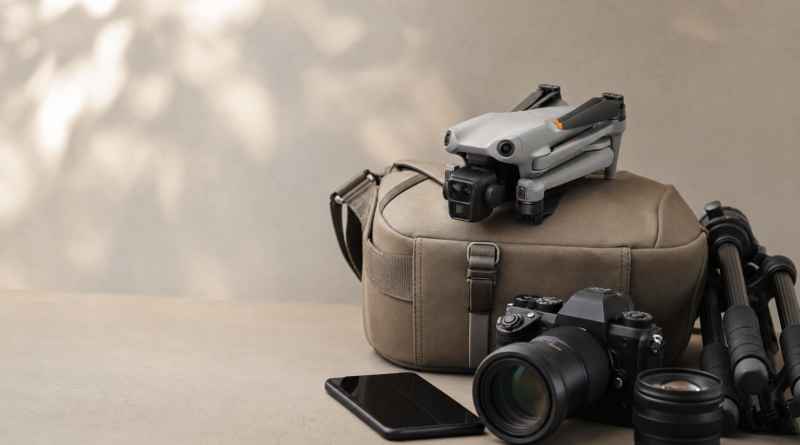
DJI Air 3S Review: Best Drone for Travel Creators?
By Adam Kozluk
Review methodology and limitations: This article evaluates the DJI Air 3S for travel photography and video using DJI’s published specifications and product documentation. Recommendations interpret the documented camera features, portability, and workflow trade-offs. This version does not include independent hands-on measurements or original flight-test footage, and it does not independently verify image quality, flight time, obstacle sensing, or return-to-home reliability. Manufacturer performance figures should be read as DJI’s claims, not results measured for this review.
Quick Verdict: Who Should Buy the DJI Air 3S?
The DJI Air 3S is one of the strongest travel drones for creators who want high-quality aerial video without moving all the way up to a larger professional drone. It gives you a useful dual-camera setup, strong video quality, better creative framing than a single-camera drone, and a travel-friendly folding design.
DJI positions the Air 3S as a dual-camera drone for travel photography, with a 1-inch CMOS primary camera, 70mm medium tele camera, 4K/60fps HDR video, up to 14 stops of dynamic range, nightscape omnidirectional obstacle sensing, and next-generation Smart RTH.
It is not the cheapest DJI drone, and it is not the right choice if you only need quick social clips. But for travel creators, YouTubers, photographers, and hybrid shooters who want cinematic aerial footage in a portable kit, the Air 3S is a very strong buy.
Check DJI AIR 3S prices on Amazon!
| Category | DJI Air 3S Verdict |
|---|---|
| Best for | Travel creators, YouTubers, photographers, aerial video, landscape footage |
| Not ideal for | Budget beginners, casual selfie-drone users, FPV pilots, people who want the smallest possible drone |
| Main reason to buy | Dual-camera flexibility with strong travel-video quality |
| Main reason to skip | More expensive and more complex than a Mini-series drone |
| Best bundle | Fly More Combo with RC 2 controller |
| Must-have accessory | Extra batteries and ND filter |
DJI Air 3S Key Specs
| Feature | DJI Air 3S |
|---|---|
| Camera system | Dual-camera setup |
| Main camera | 1-inch CMOS, 50MP wide-angle camera |
| Tele camera | 1/1.3-inch CMOS, 48MP medium tele camera |
| Equivalent focal lengths | 24mm wide + 70mm medium tele |
| Video | 4K up to 120fps, FHD up to 240fps |
| Photo format | JPEG/DNG RAW |
| Internal storage | 42GB |
| Stabilization | 3-axis mechanical gimbal |
| Transmission | DJI O4, up to 20km FCC-rated transmission range |
| Obstacle sensing | Omnidirectional vision sensing with forward-facing LiDAR |
| Battery charging hub | Charges three batteries sequentially |
DJI’s official specs list the Air 3S with a 1-inch 50MP wide camera, 1/1.3-inch 48MP medium tele camera, 4K recording up to 120fps, FHD up to 240fps, 42GB internal storage, JPEG/DNG RAW support, a 3-axis gimbal, O4 transmission, and omnidirectional sensing supported by forward-facing LiDAR.
Why the DJI Air 3S Makes Sense for Travel Creators
The strongest reason to buy the DJI Air 3S is not just “better specs.” It is the dual-camera workflow.
Most beginner drones give you one wide camera. That works for dramatic aerial landscapes, but it can make every clip look the same: wide, distant, and obviously “drone-like.” The Air 3S gives you both a 24mm wide-angle view and a 70mm medium tele view. That is a big deal for travel storytelling.
The wide camera is useful for:
- Establishing shots
- Coastlines, mountains, lakes, and cityscapes
- Big reveal movements
- Top-down travel footage
- Large outdoor scenes
The 70mm medium tele camera is useful for:
- Compressing landscapes
- Isolating buildings, roads, people, boats, and landmarks
- More cinematic parallax shots
- Less “generic drone footage”
- Travel edits that match mirrorless-camera b-roll better
This is exactly why the Air 3S is more interesting than a simple beginner drone. It gives creators more ways to compose, not just a flying wide-angle camera.
Image Quality: The Main Reason to Upgrade From a Basic Drone
The Air 3S has a 1-inch CMOS primary camera, which is the headline feature for image quality. A larger sensor helps with cleaner footage, better tonal handling, and more flexible editing than smaller-sensor drones.
The 50MP wide camera is the main tool for landscapes and classic aerial travel footage. The 48MP medium tele camera gives you tighter framing and more subject separation from the air. Both cameras support JPEG and DNG RAW for stills, which matters if you want to edit aerial photos seriously.
Buy it if:
- You want aerial footage that matches your travel camera work.
- You edit YouTube videos, reels, client travel clips, or cinematic b-roll.
- You want more creative framing than a single-camera drone.
- You shoot landscapes, cities, beaches, roads, mountains, and resorts.
Skip it if:
- You only need quick casual clips.
- You do not want to edit or color-correct footage.
- You mostly fly indoors or in tight areas.
- A smaller Mini-series drone is enough for your content.
Video Performance: Strong for YouTube, Travel Films, and Social Content
The DJI Air 3S is built for serious creator video. DJI’s official specs list 4K recording up to 120fps and Full HD up to 240fps, with H.264/H.265 recording and 10-bit options for 4K in Normal, HLG, and D-Log M modes.
For travel creators, that gives you useful flexibility:
- 4K/60fps for smooth travel footage
- 4K/120fps for slow-motion movement
- D-Log M for more flexible grading
- HLG for HDR workflows
- 2.7K vertical video for social-first content
- FHD/240fps for dramatic slow motion
This is not overkill if you create polished YouTube videos, travel reels, hotel/resort content, outdoor brand videos, or client tourism footage. It is overkill if you only want occasional drone shots for Instagram.
Practical tip: do not buy this drone without ND filters. If you want cinematic motion blur in bright daylight, ND filters are not optional.
Check DJI AIR 3s prices on Amazon!
Flight Safety and Ease of Use
The Air 3S is still a drone. You need practice. But DJI has clearly designed it to reduce the intimidation factor for travel creators.
The Air 3S includes omnidirectional dual vision sensing, forward-facing LiDAR, downward infrared sensing, and DJI’s O4 transmission system. DJI lists the FCC-rated maximum transmission range at 20km in unobstructed, interference-free conditions, though real-world range depends heavily on environment, interference, regulations, and line of sight.
For creators, the practical benefit is confidence. You still need to fly responsibly, but obstacle sensing, reliable return-to-home behavior, and strong transmission make the drone easier to trust when you are traveling.
Buy it if:
- You want a safer-feeling drone than older models.
- You travel and often fly in unfamiliar locations.
- You care about stable signal and return-to-home reliability.
- You want obstacle sensing for added confidence.
Skip it if:
- You think obstacle sensing means you cannot crash.
- You are unwilling to learn local drone rules.
- You plan to fly in crowded, restricted, or unsafe areas.
- You want FPV-style aggressive flying.
Obstacle sensing is not a license to be reckless. Trees, cables, birds, reflective surfaces, thin branches, and low light can still create problems.
Portability: Travel-Friendly, But Not Pocket-Sized
The DJI Air 3S is portable, but it is not a tiny drone. This is where buyers need to be honest.
If your top priority is the smallest possible travel kit, a Mini-series drone may make more sense. If your top priority is better footage, dual-camera flexibility, and stronger creator features, the Air 3S is the better long-term tool.
The best version for most creators is probably a Fly More Combo, because drone ownership without extra batteries becomes frustrating fast. One battery is rarely enough for a sunrise, golden hour, and multiple location angles.
Buy the standard kit if:
- You are testing whether you will actually fly often.
- You want the lowest entry price.
- You already own compatible accessories.
Buy the Fly More Combo if:
- You travel often.
- You shoot YouTube or client work.
- You want multiple batteries.
- You need a charging hub and better carry setup.
DJI Air 3S vs DJI Mini 5 Pro vs DJI Mavic 4 Pro
| Drone | Best For | Choose It If |
|---|---|---|
| DJI Air 3S | Travel creators and serious hobbyists | You want strong image quality, dual cameras, and a portable travel kit |
| DJI Mini 5 Pro | Lightweight travel and casual creators | You want the smallest practical drone kit with strong camera features |
| DJI Mavic 5 Pro | High-end aerial creators | You want flagship-level camera capability and are willing to carry/pay more |
| DJI Neo 2 / smaller beginner drones | Fun, casual, beginner flying | You care more about simplicity than image quality |
DJI’s current camera-drone lineup includes products like the Mini 5 Pro, Mavic 4 Pro, and Air 3S, with Air 3S positioned as the dual-camera travel option.
Best Accessories for the DJI Air 3S
| Accessory | Why It Matters |
|---|---|
| Extra Intelligent Flight Batteries | More flight time at each location |
| Battery charging hub | Charges multiple batteries more efficiently |
| ND filter kit | Essential for cinematic shutter speeds in daylight |
| High-speed microSD cards | Needed for reliable video recording |
| Hard case or travel bag | Protects drone, controller, props, and batteries |
| Spare propellers | Cheap insurance after rough landings |
| Landing pad | Useful on sand, grass, dirt, and snow |
| Lens cleaning kit | Helps with dust, salt spray, fingerprints, and travel grime |
| DJI Care Refresh | Worth considering if you are new to drones or travel often |
DJI’s Air 3S charging hub is designed to charge three Air 3 or Air 3S intelligent flight batteries sequentially, according to DJI’s official specs.
Buying Mistakes to Avoid
Buying the drone without extra batteries
This is the biggest beginner mistake. One battery is not enough for travel shooting. You will spend more time worrying about battery percentage than getting good shots.
Skipping ND filters
Without ND filters, bright daylight footage can look too sharp and unnatural because your shutter speed is too high. ND filters help you get more cinematic motion.
Assuming obstacle avoidance prevents all crashes
It does not. Obstacle sensing helps, but it cannot guarantee safety in every environment.
Forgetting local drone laws
Drone rules vary by country, city, park, and airspace. Check before you fly, not after you arrive.
Buying too much drone for casual clips
If you only want occasional social content, the Air 3S may be more drone than you need. A Mini-series model could be cheaper and easier to carry.
Underestimating file sizes
High-resolution video fills cards quickly. Buy reliable microSD cards and back up footage while traveling.
Who Should Buy the DJI Air 3S?
You should buy the DJI Air 3S if you are a travel creator, photographer, YouTuber, or videographer who wants better aerial footage than an entry-level drone can provide.
It is especially good for:
- Travel videos
- YouTube b-roll
- Landscape aerials
- Tourism content
- Outdoor brand work
- Resort and hotel videos
- Road trip footage
- Cityscape establishing shots
- Creators who want both wide and tighter aerial framing
The Air 3S is a strong choice when you want a serious drone but do not want to carry a larger professional model everywhere.
If you feel this is a drone for your next adventure, check the price on Amazon!
Who Should Skip the DJI Air 3S?
You should skip the DJI Air 3S if your main priority is the lowest price, the smallest travel setup, or casual flying.
Consider a smaller or cheaper drone if:
- You are completely new and unsure whether you will fly often.
- You want the lightest possible drone kit.
- You mostly make casual short clips.
- You do not want to manage batteries, ND filters, storage, and regulations.
- You need a true professional flagship drone for commercial aerial cinematography.
The Air 3S is not the drone equivalent of a phone camera. It is a serious creator tool, and it rewards people who actually plan shots.
FAQ: DJI Air 3S Review
Is the DJI Air 3S good for beginners?
Yes, but it is better for serious beginners than casual buyers. The obstacle sensing, smart flight features, and strong image quality make it approachable, but you still need to learn flight control, composition, battery management, and local drone rules.
Is the DJI Air 3S good for travel?
Yes. The DJI Air 3S is one of the best DJI drones for travel creators because it combines a portable folding design with a dual-camera system, strong video quality, and useful safety features.
Is the DJI Air 3S better than a DJI Mini drone?
It depends. The Air 3S is better if you want stronger image quality, dual-camera framing, and a more serious creator tool. A Mini drone is better if you want the smallest, lightest, and easiest travel setup.
What memory card should I use with the DJI Air 3S?
Use a reliable high-speed microSD card that can handle high-bitrate 4K video. Avoid cheap no-name cards. For travel, carry multiple cards and back up footage regularly.
Do I need ND filters for the DJI Air 3S?
Yes, if you care about cinematic video. ND filters help control shutter speed in bright light, especially for beaches, snow, mountains, cities, and midday travel shooting.
Should I buy the DJI Air 3S Fly More Combo?
For most travel creators, yes. Extra batteries, a charging hub, and a better carry setup are worth it if you plan to fly regularly.
Final Verdict: Is the DJI Air 3S Worth Buying?
The DJI Air 3S is worth buying if you want a serious travel drone with better creative flexibility than a basic single-camera model. Its dual-camera system, 1-inch primary sensor, 70mm medium tele camera, strong video options, obstacle sensing, and travel-friendly design make it one of the most useful drones for creators who want aerial footage that actually improves their videos.
Buy it if: you create travel videos, YouTube content, landscape footage, tourism content, or cinematic b-roll and want a drone that gives you both wide and tighter aerial perspectives.
Skip it if: you only need casual social clips, want the cheapest drone possible, or would rather carry the smallest drone kit.
Bottom line: the DJI Air 3S is not just a travel drone. It is a serious aerial camera for creators who want more than generic wide-angle drone shots.